How to Estimate Glass Bead Requirements for Thermoplastic Road Markings
-
 prime-shop
- Posted on
- 0 comments


Accurate estimation of glass bead requirements for thermoplastic road markings is essential for controlling project costs, maintaining consistent nighttime visibility, and achieving the required retroreflective performance. Overestimating bead quantities leads to unnecessary material costs and wastage, while underestimating them can cause insufficient coverage, inconsistent visibility, and last-minute procurement issues during application.
This guide shows road marking contractors, quantity surveyors, highway engineers, and thermoplastic applicators exactly how to calculate glass bead quantity using a clear formula, worked examples, and a practical reference table.
Why Accurate Glass Bead Estimation is Needed
Glass beads play an important role in the optical performance of thermoplastic road markings. When properly distributed and embedded in the marking, they help return incident headlamp light toward approaching drivers, improving nighttime visibility.
Incorrect estimation can create several practical problems:
- Overestimation: Excess inventory, unnecessary procurement expenditure and material wastage.
- Underestimation: Shortage during application, project delays and inconsistent bead coverage.
- Incorrect application: Poor bead distribution or embedment can reduce the expected nighttime visibility.
- Budget overruns: A small error in rate or area calculation can become significant across large highway projects.
- Performance risks: Quantity alone does not guarantee retroreflectivity because bead size, optical properties, distribution and embedment also influence performance.
Drop-On vs Intermix Glass Beads
Before performing a glass beads thermoplastic calculation, it is important to understand whether the project uses drop-on beads, intermix beads, or a combination of both.
1. Drop-On Glass Beads
Drop-on glass beads are distributed over the surface of freshly applied thermoplastic while the material is still capable of receiving and retaining the beads. Proper timing and embedment are important because the exposed portion of each bead contributes to retroreflective performance. The road marking glass bead application rate is normally expressed in grams per square metre (g/m²).
Typical drop-on rates for thermoplastic road markings commonly fall between 250–600 g/m² (approximately 0.25–0.60 kg/m²). Many project specifications use rates in the 300–400 g/m² range. This should not be treated as a universal requirement — always follow the rate stated in the project specification, bead characteristics, and application system.
2. Intermix Glass Beads
Intermix glass beads are incorporated into the thermoplastic material rather than being applied only to its surface. Their purpose and quantity therefore need to be considered as part of the material formulation.
This distinction is important: a drop-on application rate should not automatically be substituted for an intermix percentage or formulation requirement. If a project specification requires both, calculate and document each component separately.
Intermix beads are usually specified as a percentage by mass of the thermoplastic material (commonly in the range of 18–30%, depending on the standard and product formulation). Do not use a drop-on surface rate for intermix calculations.
Glass Bead Estimation Formula
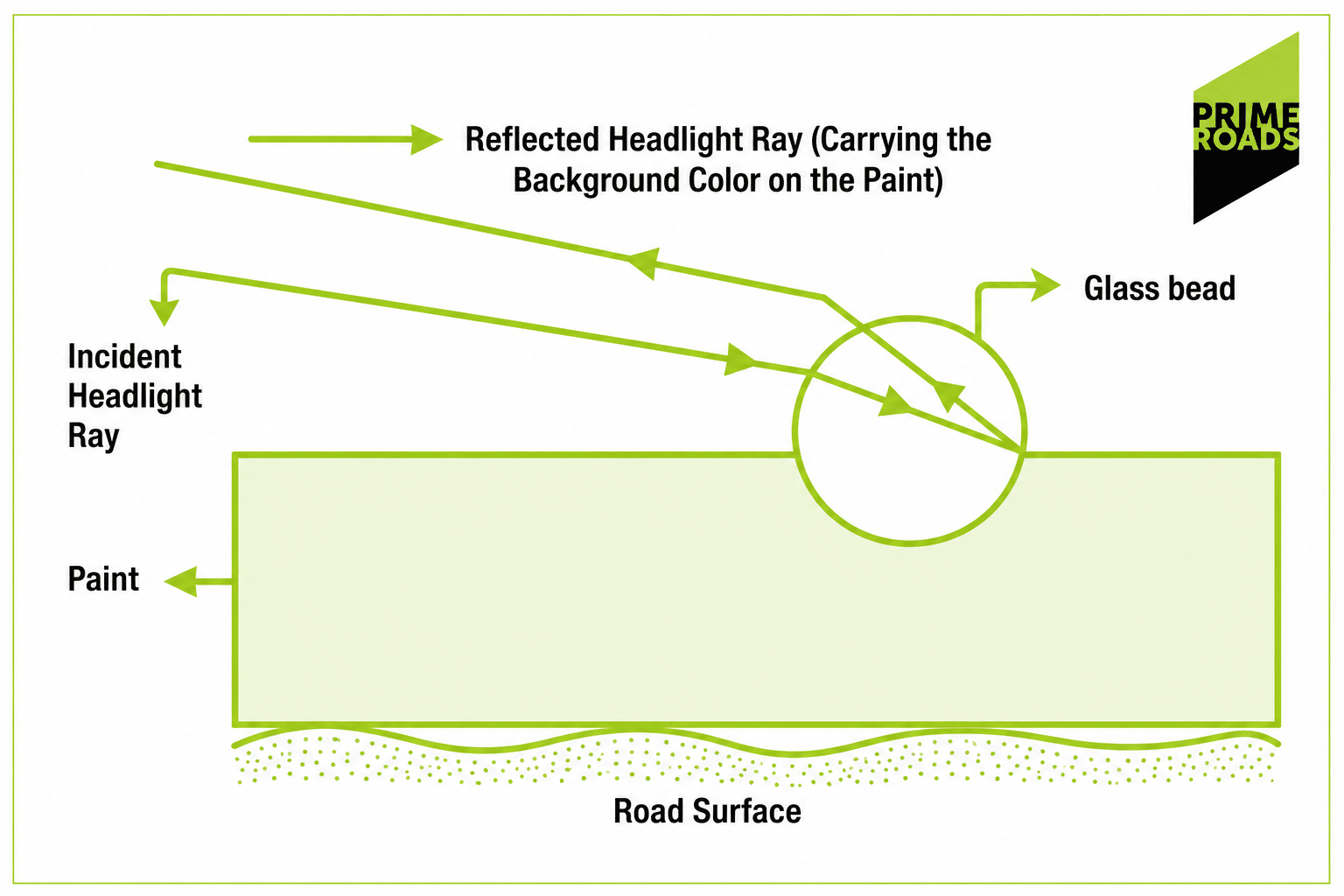 The basic glass bead estimation formula requires two main values: total marking area and bead application rate.
Step 1: Calculate the Marking Area
- For a continuous line: Marking Area (m²) = Length (m) × Width (m)
- For multiple continuous lines: Total Marking Area = Length × Width × Number of Lines
Always convert the line width into metres before performing the calculation.
Step 2: Calculate Glass Bead Quantity
Once the marking area is known: Glass Bead Quantity (kg) = Marking Area (m²) × Application Rate (g/m²) ÷ 1,000
The division by 1,000 converts grams into kilograms.
For procurement planning, the calculation can then be adjusted for a project-approved allowance:
Order Quantity = Theoretical Quantity × (1 + Allowance)
The allowance should reflect actual project conditions rather than being applied blindly.
How to Calculate Glass Bead Requirements Step by Step
The following process can be used by a project estimator before ordering material.
1. Measure the marking length
Determine the total length of each marking category, such as lane lines, edge lines, stop lines or directional markings.
2. Confirm the marking width
Record the specified width in millimetres and convert it into metres.
3. Determine the actual marking area
Multiply length by width and account for the number of lines. For broken markings, calculate only the painted segments.
4. Confirm the bead application rate
Use the rate specified by the project, applicable standard, material supplier or application system. Do not assume that one rate is appropriate for every bead or thermoplastic system.
5. Convert the rate into kilograms
Divide the g/m² rate by 1,000 when calculating the final quantity in kilograms.
6. Calculate theoretical consumption
Multiply the marking area by the selected rate.
7. Consider application losses
Site handling, equipment calibration, wind, overspray and application variation may affect actual consumption. Any allowance should be established according to project practice.
8. Validate the result
Check the calculated quantity against the required retroreflectivity, bead specification, application method and project documentation.
This approach helps contractors establish the glass bead requirements for thermoplastic road markings before procurement rather than relying on approximate quantities.
Worked Example of Glass Bead Calculation
Consider the following hypothetical project:
| Parameter | Hypothetical Value |
| Line length | 1,000 m |
| Line width | 100 mm |
| Number of continuous lines | 2 |
| Bead application rate | 300 g/m² |
Step 1: Convert Line Width
100 mm = 0.10 m
Step 2: Calculate Total Marking Area
Area = 1,000 × 0.10 × 2 = 200 m²
Step 3: Calculate Bead Quantity
Quantity = 200 × 300 ÷ 1,000 = 60 kg
Therefore, the theoretical requirement is 60 kg of glass beads at an illustrative application rate of 300 g/m². If the project specifies a procurement allowance, that allowance would be applied to the 60 kg figure before final ordering.
Note: This is a hypothetical calculation intended to demonstrate the method. It is not a Prime Roads application-rate recommendation or project specification.
Glass Bead Quantity Reference Table
The following table provides quick reference values using an illustrative rate of 300 g/m² for continuous markings.
| Line Width | Length | Marking Area | Glass Beads @ 300 g/m² |
| 50 mm | 100 m | 5 m² | 1.5 kg |
| 50 mm | 500 m | 25 m² | 7.5 kg |
| 50 mm | 1,000 m | 50 m² | 15 kg |
| 75 mm | 100 m | 7.5 m² | 2.25 kg |
| 75 mm | 500 m | 37.5 m² | 11.25 kg |
| 75 mm | 1,000 m | 75 m² | 22.5 kg |
| 100 mm | 100 m | 10 m² | 3 kg |
| 100 mm | 500 m | 50 m² | 15 kg |
| 100 mm | 1,000 m | 100 m² | 30 kg |
| 150 mm | 100 m | 15 m² | 4.5 kg |
| 150 mm | 500 m | 75 m² | 22.5 kg |
| 150 mm | 1,000 m | 150 m² | 45 kg |
These are theoretical values for continuous markings. For broken/dashed lines, calculate only the actual painted length (exclude gaps). Always apply the project-approved allowance for handling and application losses.
Factors That Can Change Glass Bead Consumption
Although area and application rate provide the basic calculation, several factors can influence the final requirement.
 Bead Size
 Bead Size
Glass bead size affects distribution, embedment and optical behaviour. Different bead gradations may therefore require different application practices. The selected bead should match the thermoplastic system and project specification.
Refractive Index
The refractive index influences how effectively light interacts with the bead. Since retroreflection depends on the optical behaviour of the bead, selecting material based only on weight can overlook an important performance characteristic.
Embedment Depth
Beads need controlled embedment in the thermoplastic surface. If they are insufficiently embedded, retention can be affected. If they become excessively submerged, the exposed optical surface may be reduced.
Therefore, simply increasing the retroreflective glass beads quantity does not automatically guarantee better nighttime performance.
Weather Conditions
Temperature, moisture, rain and wind can influence application quality. Damp pavement or unsuitable application conditions can interfere with adhesion and bead retention, while wind can contribute to uneven distribution.
Application Equipment
Automatic bead dispensers and other application systems need appropriate calibration to maintain the intended thermoplastic bead drop rate. Poor calibration can cause actual consumption to differ significantly from the theoretical calculation.
Thermoplastic Thickness
Thermoplastic thickness primarily influences thermoplastic material consumption rather than directly determining the bead rate. Glass bead quantity should therefore be calculated separately using the specified bead application rate.
Common Mistakes to Avoid
- Using the total road length instead of actual painted area for broken lines
- Applying a drop-on rate to intermix calculations
- Ignoring project-specific allowances and losses
- Focusing only on quantity without checking embedment and distribution
Over-Application vs Under-Application
| Aspect | Under-Application | Over-Application |
| Material consumption | Lower | Higher |
| Procurement risk | Possible shortage | Excess inventory |
| Night visibility | May be inadequate | May not improve proportionally |
| Retroreflectivity | Can fall below target | Depends on distribution and embedment |
| Cost impact | Rework or additional supply | Increased material cost |
| Surface distribution | Potentially sparse | Potentially excessive |
The objective should not be to apply as many beads as possible. The goal is controlled application at the specified rate with suitable distribution and embedment.
How Glass Bead Quantity Relates to Retroreflectivity
The relationship can be understood as:
Bead specification → application rate → distribution → embedment → optical performance → retroreflectivity
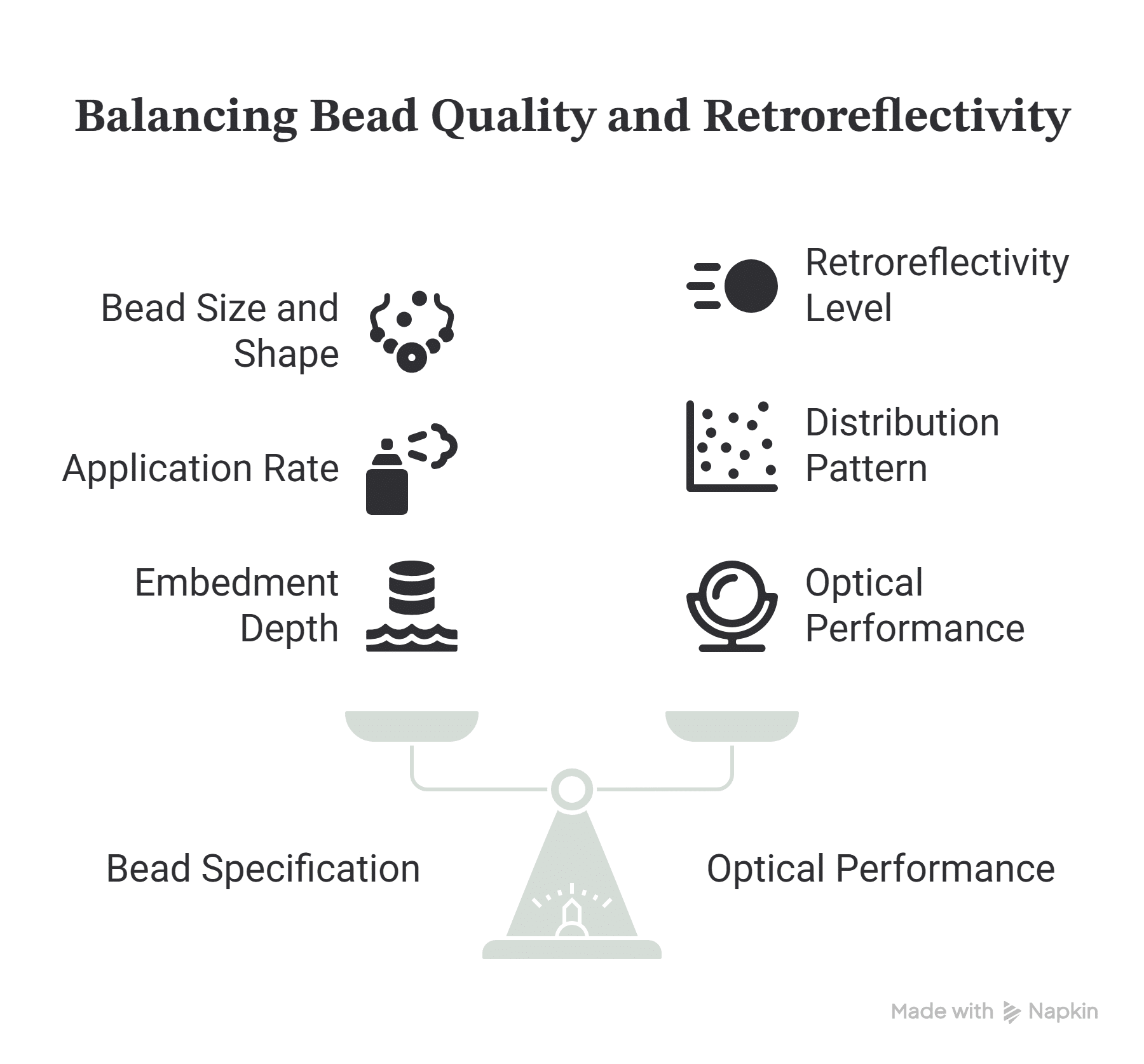
This means that quantity is only one part of the performance equation. Prime Roads thermoplastic products are positioned for applications requiring visibility, durability and road-marking performance; for example, its Primeline Standard is described as an IRC-oriented product with day and nighttime visibility, while Primeline BS is formulated around British Standard requirements. For a project with a defined minimum retroreflectivity requirement, the applicable specification and testing procedure should remain the final reference.
How to Convert the Calculation Into an Order Quantity
Before placing an order, quantity surveyors and contractors can use this checklist:
- Confirm total marking length.
- Record every line width.
- Separate continuous and broken markings.
- Calculate the actual painted area.
- Confirm the specified bead type and application method.
- Verify the applicable bead application rate.
- Calculate theoretical consumption in kilograms.
- Account for project-approved application losses.
- Check the required retroreflectivity and other performance criteria.
- Confirm packaging and final procurement quantity with the supplier.
Frequently Asked Questions
1. How many kg of glass beads are required per km of road marking?
It depends on line width, number of lines, and application rate. For example, two continuous 100 mm lines over 1 km at 300 g/m² require 60 kg of glass beads.
2. What is the standard glass bead application rate for thermoplastic?
There is no single universal rate. Typical drop-on rates range from 250–600 g/m². Always follow the rate specified in your project documents.
3. Should I calculate intermix and drop-on beads the same way?
No. Drop-on beads are calculated by area (g/m²). Intermix beads are usually specified as a percentage by mass of the thermoplastic material.
Final Words
Prime Roads offers dependable thermoplastic road marking paints and reflective glass bead solutions designed for diverse road infrastructure applications. With established manufacturing capabilities and technical expertise, we support contractors, infrastructure developers, and road-marking professionals with application-focused products tailored to project requirements.
❓Planning a highway, urban road, or infrastructure marking project? Share your project requirements with Prime Roads Today!