Thermoplastic Road Marking Paint: Price and Quality Buying Guide
-
prime-shop
- Posted on
- 0 comments
Introduction
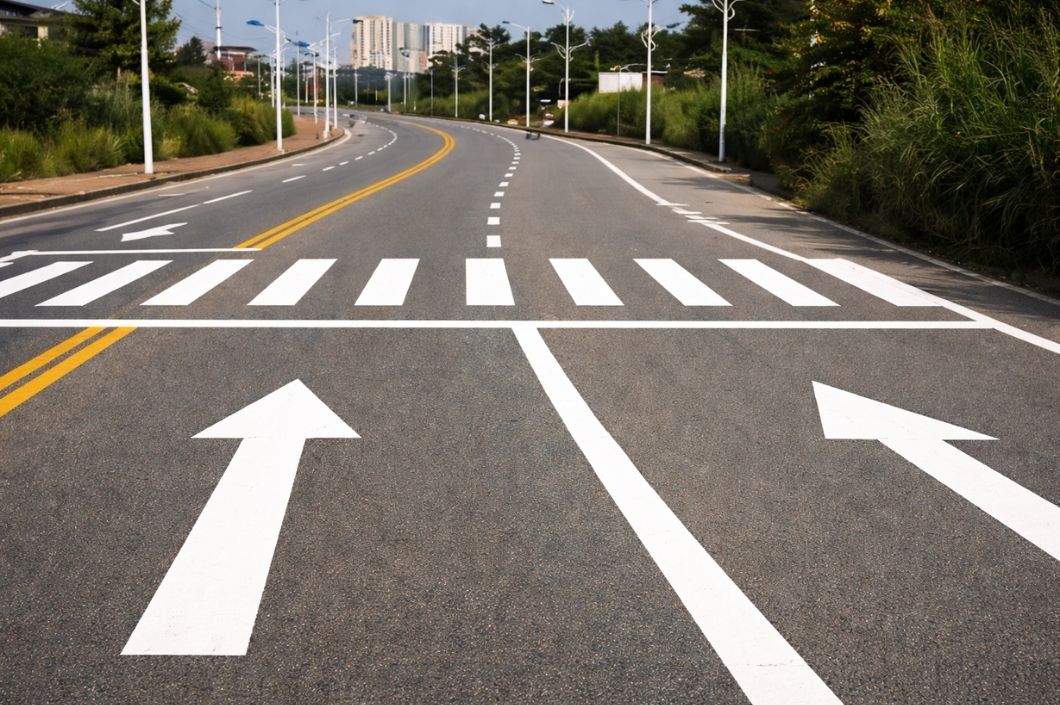
Modern road infrastructure depends on visibility, durability, and safety compliance. Thermoplastic road marking paint is one of the most essential materials enabling this — from national highways to city roads, airport runways, and industrial zones, these markings guide traffic, reduce accidents, and support driving discipline.
As infrastructure investments rise across India and the Middle East, understanding the balance between price and quality has become critical for procurement managers, road contractors, and project planners.
This guide covers everything you need to make an informed buying decision: actual price ranges by grade, quality benchmarks, reflectivity standards, paint type comparisons, application-specific recommendations, and a reference list of leading manufacturers in India.
Why Quality Is Critical When Buying Thermoplastic Road Marking Paint
Many buyers focus primarily on price per kg during the purchasing stage. While budget control matters, selecting on price alone almost always results in higher total project costs over time.
What low-quality thermoplastic paint looks like in practice
- Fades and loses colour stability within 6–8 months under heavy traffic
- Glass beads fall out early, reducing night-time visibility before the marking wears out
- Cracks or peels under thermal cycling, especially in extreme climates
- Fails inspection under MORTH or IRC:35 standards, triggering rework costs
What high-quality thermoplastic paint delivers
- Longer repainting cycles — 24–36+ months on highways vs 6–12 months for economy grade
- Consistent retroreflectivity throughout the service life, not just on day one
- Resistance to heavy axle loads and abrasion
- Compliance with safety standards required for government and NHAI tenders
Thermoplastic Road Marking Paint — Price Ranges in 2026
Prices vary based on material grade, glass bead content, order volume, and supplier location. The ranges below represent indicative market rates for bulk orders (1 tonne+) from Indian manufacturers. Prices may vary based on raw material costs, freight, and custom formulations.
| Price range | Quality level | Durability | Typical price (₹/kg) | Best for |
| Economy grade | Basic formulation | 6–12 months | ₹55–₹70/kg | Temporary markings, low-traffic roads |
| Mid-range grade | Standard compliance | 12–24 months | ₹70–₹95/kg | City roads, municipal projects |
| Premium grade | High-performance | 24–36+ months | ₹95–₹130/kg | Highways, expressways, airports |
Factors that affect final price
- Resin quality and grade — higher-grade hydrocarbon resins increase cost but significantly improve adhesion and durability
- Glass bead percentage — premium formulations contain 18–22% premix glass beads vs 12–15% in economy grades
- Application thickness — standard 2.5 mm vs 3.0–4.0 mm for heavy-duty applications
- Order volume — bulk orders of 5 MT+ typically attract 8–15% discounts
- Packaging and logistics — export-grade moisture-resistant packaging adds to FOB cost
- Certifications — BIS and MORTH-compliant products carry a quality premium
Cost per square metre (rate analysis): At 2.5 mm thickness, 1 tonne of thermoplastic paint covers approximately 120–140 m² depending on surface porosity. At ₹85/kg (mid-range), the material cost per m² is approximately ₹6.5–₹7.5 — excluding application labour and equipment.
Types of Road Marking Paint — Comparison Guide
Thermoplastic is the most widely used road marking material in India, but it is not the only option. Understanding the alternatives helps you match the right product to your application and budget.
| Type | Cost (₹/kg) | Durability | Application | Reflectivity | Best use |
| Hot-applied thermoplastic | ₹70–₹130 | 2–4 years | 180–220°C screed/spray | High (glass beads) | Highways, national roads |
| Cold plastic (MMA) | ₹150–₹250 | 3–5 years | Ambient temp, 2-part mix | Very high | High-wear zones, crossings |
| Epoxy road paint | ₹120–₹200 | 2–3 years | Spray or roller | Medium | Parking lots, factories |
| Water-based paint | ₹30–₹55 | 3–6 months | Spray, ambient | Low | Temporary, low-traffic |
For most Indian government tender requirements — NHAI, PWD, municipal corporations — hot-applied thermoplastic remains the standard specified material. Cold plastic (MMA) is increasingly specified for high-wear urban intersections and pedestrian crossings where premium durability justifies the higher cost.
Retro Reflectivity — The Quality Metric Buyers Often Miss
Retro reflectivity is the ability of a road marking to reflect vehicle headlights back toward the driver at night. It is the primary safety-performance metric for road markings — and the one most frequently overlooked during procurement.
Retro reflectivity is measured in mcd/m²/lux (millicandelas per square metre per lux) under the EN 1436 and IRC:35 standards. Higher values mean better night-time visibility.
How glass beads create retro reflectivity
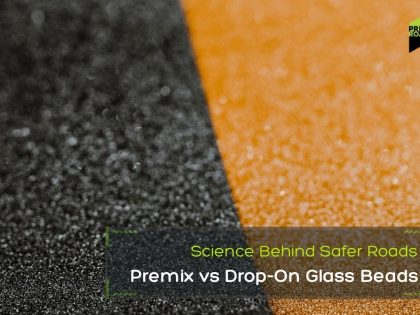
Glass beads embedded in the thermoplastic surface act as tiny retroreflectors — they refract incoming headlight beams back along the same direction. Two types of beads work together:
- Premix beads — mixed into the paint during manufacturing; provide retroreflectivity as the surface wears down
- Drop-on beads — applied to the surface immediately after laying; provide high initial retroreflectivity from day one
Economy-grade thermoplastic often uses fewer beads (12–15% premix) or lower-quality beads with inconsistent size distribution. Premium formulations use 18–22% premix beads plus drop-on application, maintaining RL values above specification throughout the service life.
Minimum retro reflectivity requirements by application
| Application | Minimum RL (mcd/m²/lux) | Recommended RL | Standard reference |
| National highways | 100 | 150–300 | IRC:35 / MORTH |
| City roads | 80 | 100–200 | IRC:35 |
| Airports / runways | 150 | 200–400 | ICAO / EN 1436 |
| Pedestrian crossings | 100 | 150–250 | IRC:35 / BS EN 1436 |
When evaluating suppliers, always request third-party test reports showing RL values at time of manufacture and after accelerated wear testing. A supplier that cannot provide these reports is unlikely to meet IRC:35 or MORTH compliance requirements.
Road Marking Paint by Application — What to Specify
Different road marking applications require different paint specifications. Using the wrong grade wastes budget or fails compliance audits. The table below maps common applications to the correct specification.
| Application | Recommended paint type | Colour | Thickness (mm) | Standard |
| Highway lane marking | Hot-applied thermoplastic | White / Yellow | 2.5–3.0 mm | MORTH / IRC:35 |
| Zebra crossing | Thermoplastic / cold plastic | White | 3.0–4.0 mm | IRC:35 section 4 |
| Kerb painting | Kerb paint / thermoplastic | Black & white / Yellow | 1.0–1.5 mm | PWD / municipal specs |
| Speed breaker marking | Thermoplastic / reflective | Yellow / White | 3.0–4.0 mm | IRC:99 |
| Parking lot | Thermoplastic / epoxy | White / Yellow | 1.5–2.5 mm | IS 5600 |
| Airport runway | Premium thermoplastic / MMA | White / Yellow | 2.0–3.0 mm | ICAO Annex 14 / AAI specs |
What to verify before finalising a manufacturer
- Valid BIS licence (IS 164) or MORTH approval for the specific product
- ISO 9001 certification for manufacturing process quality
- Recent third-party test reports (not older than 12 months) for retroreflectivity, softening point, and skid resistance
- Export capability and documentation experience if procuring from outside India
- Minimum order quantity and lead time — critical for project scheduling
- Post-supply technical support and application guidance availability
Do You Need Paint Supply, Application Services, or Both?
A common source of project delays is misaligned procurement — buying paint without confirming application capability, or hiring contractors without securing material supply. Understanding which you need before approaching a supplier saves time and cost.
If you need paint supply only
You have an in-house application team or a subcontracted road marking contractor. You need:
- Material to specification (grade, colour, thickness)
- Timely delivery to site in moisture-resistant packaging
- Batch test certificates for site inspection sign-off
- Technical data sheet and MSDS for each product
Conclusion
Choosing the right thermoplastic road marking paint in 2026 means balancing cost efficiency, long-term visibility, and safety compliance. Price is a necessary input — but the real value calculation is cost per square metre over the service life, not cost per kilogram at purchase.
By understanding quality benchmarks, retroreflectivity requirements, paint type differences, and manufacturer capability, procurement managers and road contractors can make decisions that reduce total project cost and deliver safer road markings that last.
Prime Roads supplies certified thermoplastic road marking paints across India and internationally, with technical support, in-house manufacturing across 5 units, and compliance with MORTH, IRC:35, BIS, and BS EN 1871 standards.
🛣️For a project-specific quotation or sample request, contact the Prime Roads team at sales@primeroads.com.