

Cold Road Marking Paint: Buyer’s Guide to Application, Lifespan & Best Use Cases
-
 prime-shop
 - Posted on
- 0 comments

Road markings play a critical role in maintaining traffic discipline, improving road safety, and enhancing visibility for drivers and pedestrians. Selecting the right road marking material directly impacts performance, maintenance costs, and long-term durability.
Among the various marking solutions available today, cold road marking paint has become a popular choice for projects that require cost-effective application, quick installation, and operational flexibility. However, many contractors and procurement teams often face questions such as:
- Is cold paint suitable for my project?
- How long will it last?
- Is it better than thermoplastic markings?
- What factors affect durability?
- How can premature wear be avoided?
This buyer’s guide answers these questions and provides practical insights into application methods, lifespan considerations, and ideal use cases for cold road marking systems.
What Is Cold Road Marking Paint?
Cold road marking paint is a road marking material that can be applied directly to the pavement surface without heating equipment. Unlike thermoplastic, which must be melted before application, cold-applied paints are supplied in liquid or two-component forms and are sprayed, rolled, or machine-applied onto the road surface.
They’re used to create lane lines, pedestrian crossings, parking bays, directional arrows, and safety markings, and modern formulations — particularly MMA — are compatible with reflective glass beads for strong night-time visibility.
Types of Cold Road Marking Paint
Not all cold-applied markings perform the same way. The right choice depends on traffic volume, budget, and how long the markings need to last.
1. Water-Based Road Marking Paint
Common for urban roads, parking facilities, and low-to-medium traffic applications. Environmentally friendly, low VOC, easy cleanup — but the least durable option and best suited to markings that will be repainted often.
2. Solvent-Based Road Marking Paint
Stronger adhesion and better moisture/weather resistance than water-based paint. A reasonable mid-tier option for aged pavements or projects in variable weather, still below MMA and thermoplastic on long-term durability.
3. MMA Road Marking Paint (Cold Plastic)
MMA, or methyl methacrylate paint, is a two-component cold plastic system: a base material and a curing agent that chemically cross-link once mixed, rather than drying by evaporation like water- or solvent-based paint. That’s the mechanical reason it performs closer to thermoplastic than to standard cold paint.
Key characteristics:
- Fast cure — ready for traffic in minutes, without any heating equipment
- Strong adhesion to both asphalt and concrete
- Resistant to UV exposure, abrasion, and chemical exposure
- Skid-resistant finish, improving traction in wet conditions
- Suitable for highways, pedestrian crossings, parking lots, industrial floors, and runways
Prime Roads manufactures and supplies MMA road marking paint engineered for heavy-traffic conditions — Request a quote Now.
Where Is Cold Road Marking Paint Best Used?
Choosing the right application area is essential for maximizing performance and return on investment.
Urban Roads and Municipal Streets
City roads often require regular maintenance and modifications due to utility works, traffic management changes, and urban development. Cold-applied paints offer flexibility and ease of reapplication, making them ideal for municipal authorities.
Parking Lots and Commercial Complexes
Parking facilities require clearly visible markings for vehicle movement and space allocation. Cold paint for road marking is widely used in parking bays, directional signage, loading zones, and pedestrian pathways.
Industrial Facilities and Warehouses
Factories, logistics parks, and warehouses use pavement markings for safety and operational efficiency. These areas typically benefit from fast application and minimal downtime.
Bicycle Lanes and Pedestrian Areas
Dedicated cycling lanes and pedestrian crossings require highly visible markings. Cold plastic systems often provide better durability in these applications.
Highways, Airports, and Runways
This is where MMA distinguishes itself from standard cold paint. Its heavy-traffic durability, chemical resistance, and skid resistance make it suitable for highway lane markings and runway marking — applications where standard water- or solvent-based cold paint would wear out too quickly.
Can Cold Road Marking Paint Be Applied on Asphalt and Concrete?
Application on Asphalt
Asphalt is generally the most suitable surface for cold-applied markings, offering good adhesion and surface texture. Properly prepared asphalt typically delivers strong bonding, better mechanical grip, and easier maintenance.
Application on Concrete
Concrete is more porous and can retain moisture, so surface cleaning and moisture control remain important regardless of paint type. Standard water- and solvent-based cold paints often benefit from a primer on concrete. MMA is formulated for strong adhesion to both asphalt and concrete, which reduces — though doesn’t always eliminate — the need for a separate primer step; confirm surface-specific recommendations against the manufacturer’s technical data sheet before specifying.
Step-by-Step Application Process
Correct installation directly influences performance and durability.
Step 1: Surface Inspection
Check for dust, oil contamination, loose aggregates, deteriorated existing markings, and surface cracks.
Step 2: Surface Cleaning
Remove contaminants using mechanical sweeping, air blowers, pressure washing, or surface grinding where necessary.
Step 3: Moisture Assessment
The pavement should be sufficiently dry before application. Excess moisture can affect adhesion and lead to premature failure.
Step 4: Layout and Pre-Marking
Measure and mark layouts accurately to ensure compliance with project specifications.
Step 5: Paint Application
Apply using airless spray systems, line marking machines, rollers, or hand-operated applicators, following the manufacturer’s recommended thickness. For MMA, base and curing agent are mixed in the specified ratio immediately before application.
Step 6: Glass Bead Application
Reflective glass beads are applied immediately after painting to improve night-time visibility and retroreflectivity.
Step 7: Drying and Traffic Opening
Standard water- and solvent-based cold paints typically need [confirm exact range] to dry sufficiently for traffic. MMA cures chemically and is typically ready for traffic within minutes rather than hours — verify the exact figure against the current technical data sheet before publishing.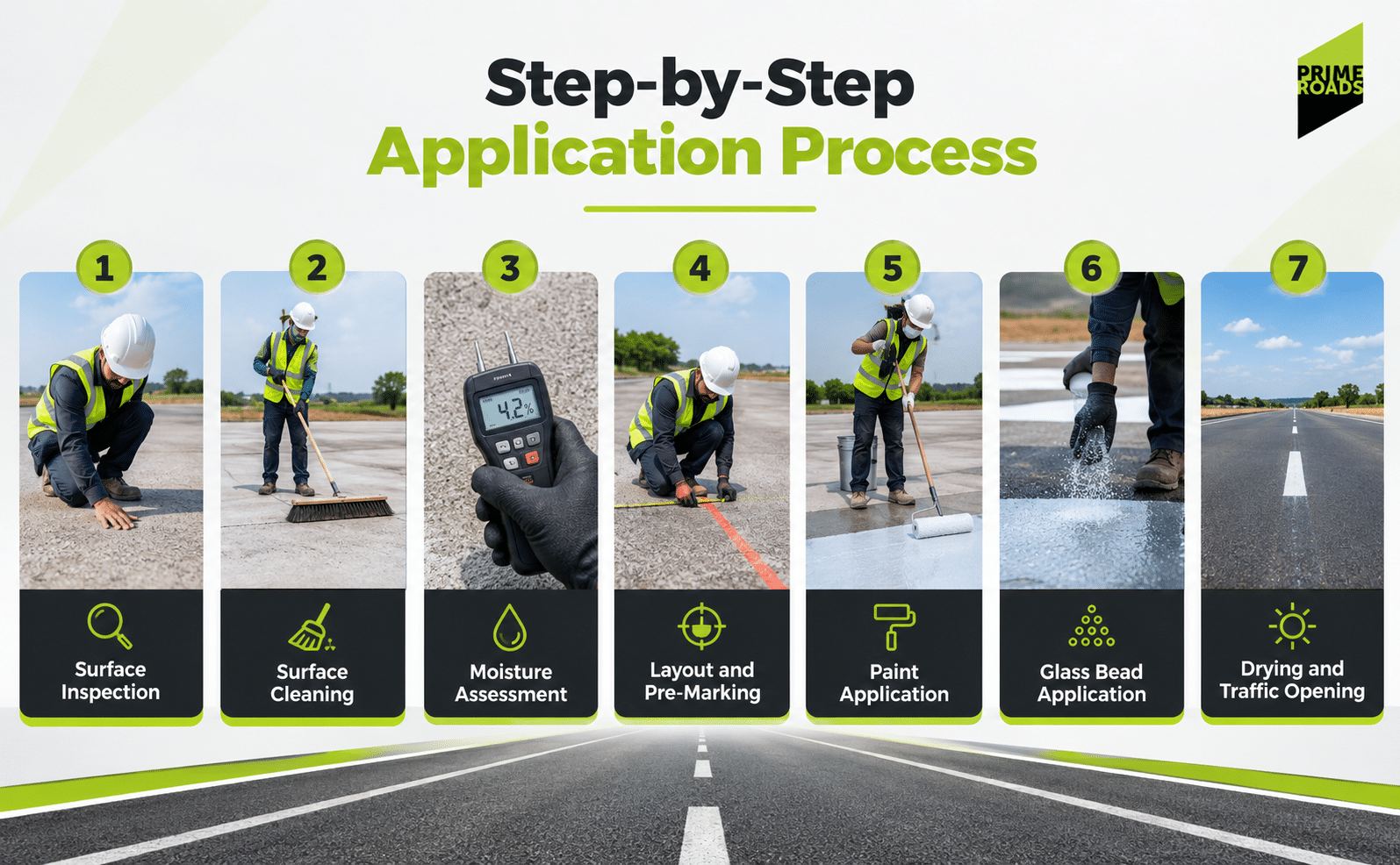
What Factors Affect the Lifespan of Cold Road Marking Paint?
One of the most common buyer questions is, “How long does cold road marking paint last?” There is no universal lifespan because durability depends on multiple project-specific factors.
- Traffic Volume — heavy traffic causes faster abrasion; this is precisely where MMA’s wear resistance separates it from standard cold paint
- Climate Conditions — UV radiation, rainfall, temperature swings, and humidity all affect performance; MMA’s UV and weather resistance is a stated advantage here
- Surface Condition — cracked or deteriorated pavement accelerates degradation regardless of paint type
- Application Thickness — too thin reduces durability; too thick can affect curing and adhesion
- Surface Preparation Quality — most premature failures trace back to inadequate cleaning and prep
- Reflective Bead Retention — visibility depends on how well beads stay embedded, not just on the paint itself
Cold Road Marking Paint vs MMA vs Thermoplastic
| Factor | Standard Cold Paint (Water/Solvent-Based) | MMA (Cold Plastic) | Thermoplastic |
| Application | No heating required | No heating required — two-component chemical cure | Heat applied (180–220°C) |
| Equipment | Simple sprayers/rollers | Simple mixing + applicator | Specialized heating equipment |
| Cure / Ready for Traffic | Minutes to hours (weather-dependent) | Minutes — cures by chemical reaction, not evaporation | Minutes after cooling |
| Initial Cost | Lowest | Moderate–higher | Higher |
| Durability | Moderate | High — approaches thermoplastic in wear resistance | High |
| Traffic Suitability | Low to medium traffic | Medium to heavy traffic, including highways and runways | Medium to high traffic |
| Skid Resistance | Standard | Skid-resistant finish | High (with aggregate/beads) |
| Weather/Chemical Resistance | Moderate | Strong UV, abrasion and chemical resistance | Strong |
| Maintenance Frequency | More frequent | Infrequent | Least frequent |
Thermoplastic remains the benchmark for the very highest traffic volumes and longest service life. MMA closes much of that gap without requiring heating equipment, making it a strong middle ground for highways, runways, and heavy-traffic sites where thermoplastic’s setup requirements aren’t practical.
Common Reasons Road Markings Fail Prematurely
Understanding failure causes helps prevent unnecessary maintenance costs.
- Poor Surface Preparation — reduces adhesion and service life
- Incorrect Thickness — affects curing and wear resistance
- Moisture During Application — causes peeling and weak bonding
- Heavy Traffic Exposure Without the Right Material — standard cold paint on high-traffic roads wears out fast; this is the most common reason projects should be specifying MMA or thermoplastic instead
- Inferior Material Quality — leads to poor visibility and frequent repainting
- Extreme Weather — UV, rain, and temperature changes reduce performance in materials without weather-resistant formulations
Buyer’s Checklist for Selecting Cold Road Marking Paint
Before purchasing cold road marking paint, consider the following checklist:
- Traffic Assessment — low/medium traffic can use standard cold paint; medium-to-heavy traffic, highways, or runways should specify MMA
- Surface Type — asphalt or concrete
- Climate Conditions — is the project exposed to harsh weather, UV, or chemical exposure?
- Visibility Requirements — are reflective markings required?
- Maintenance Expectations — how frequently can repainting be performed?
- Project Budget — available installation and maintenance budget
- Compliance Requirements — does the material meet relevant project specifications?
- Supplier Expertise — does the supplier provide technical support and application guidance?
Frequently Asked Questions
Is cold-applied paint suitable for my project?
Yes, for most low-to-medium traffic applications — municipal roads, parking lots, and pedestrian areas. For highways, runways, or other heavy-traffic sites, MMA (cold plastic) paint is the better-suited cold-applied option, since it’s built for exactly that load without requiring heating equipment.
How long will cold road marking paint last?
Standard water- or solvent-based cold paint typically needs more frequent repainting under moderate-to-heavy traffic. MMA lasts significantly longer under the same conditions due to its wear, UV, and chemical resistance. Exact service life depends on traffic volume, surface prep, and climate — [confirm typical lifespan range with Prime Roads’ technical team before publishing].
Is MMA better than standard cold paint?
For medium-to-heavy traffic, yes. MMA cures chemically rather than by evaporation, so it reaches trafficable strength faster, bonds more strongly to asphalt and concrete, and resists UV, abrasion, and chemical exposure better than water- or solvent-based cold paint.
Is MMA better than thermoplastic?
Thermoplastic still leads on sheer longevity for the very highest-traffic roads, but it requires heating equipment and longer setup. MMA delivers comparable durability for highways and runways without the heating step, making it the more practical choice where fast turnaround matters.
How fast does MMA road marking paint cure?
MMA cures through a chemical reaction between its two components rather than by drying, so it’s typically ready for traffic within minutes of application — much faster than standard cold paint drying times.
What factors most affect cold road marking paint’s lifespan?
Traffic volume and surface preparation quality are the two biggest factors, followed by climate exposure (UV, rain, temperature swings) and application thickness.
Why Choose Prime Roads for MMA Road Marking Paint?
Prime Roads manufactures MMA road marking paint engineered for heavy-traffic roads, highways, and runways, with strong adhesion to both asphalt and concrete and resistance to UV, abrasion, and chemical exposure. Stock is held across warehouses in Trichy, Bengaluru, Hubli, Mysore, Gulbarga, Lucknow, Varanasi, Meerut, Ahmednagar, Guwahati, Jaipur, Ranchi, Patna, Samastipur, Muzaffarpur, Haridwar, Cochin, and Ahmedabad for fast delivery across India.
If you are looking for dependable road marking materials and expert technical guidance, Prime Roads offers a complete range of road marking solutions designed to enhance visibility, safety, and long-term pavement performance.
Looking for the very highest-durability option instead? Explore Prime Roads thermoplastic road marking paints.


