

Road Marking Paint for Smart Cities: The Future of Intelligent Transportation
-
 prime-shop
 - Posted on
- 0 comments

As cities worldwide adopt digital transformation and sustainable urban development, transportation infrastructure is undergoing a major evolution. Smart cities are no longer a futuristic concept, they are becoming a reality through connected technologies, intelligent traffic systems, and data-driven mobility solutions.
While technologies such as smart traffic signals, connected vehicles, and real-time traffic monitoring often receive the spotlight, one critical component of intelligent transportation is frequently overlooked: Road Marking Paint for Smart Cities. High-performance road markings serve as the foundation of safe, efficient, and intelligent road networks by improving visibility, guiding road users, supporting automated vehicle systems, and enhancing overall traffic management.
As smart cities continue to expand, advanced road marking solutions are becoming essential for building safer roads, reducing accidents, and enabling the future of intelligent transportation.
The Rise of Smart Cities and Intelligent Transportation Systems
Urban populations are growing at an incomparable rate creating increasing pressure on transportation infrastructure. To address congestion, safety concerns, and environmental challenges, governments and urban planners are investing heavily in smart city initiatives.
Intelligent Transportation Systems (ITS) combine advanced communication technologies, sensors, data analytics, and automation to optimize traffic flow and improve mobility. These systems aim to:
- Reduce traffic congestion
- Improve road safety
- Enhance public transportation efficiency
- Lower environmental impact
- Support connected and autonomous vehicles
However, even the most advanced transportation technologies require reliable physical infrastructure. Road markings act as a visual communication system that guides drivers, cyclists, pedestrians, and increasingly, vehicle cameras and sensors.
Without clear and durable road markings, intelligent transportation systems cannot achieve their full potential.
What Are Smart Road Markings?
Traditional road markings primarily focused on traffic organization. Modern smart road markings, however, are designed to deliver enhanced performance and support intelligent transportation networks.
A smart road marking goes beyond simple lane delineation. It incorporates features that improve visibility, durability, and compatibility with emerging transportation technologies. Key characteristics include:
- High retro reflectivity
- Superior daytime brightness
- Long-lasting performance
- Weather resistance
- Skid resistance
- Machine-readable visibility for vehicle cameras
- Improved safety guidance
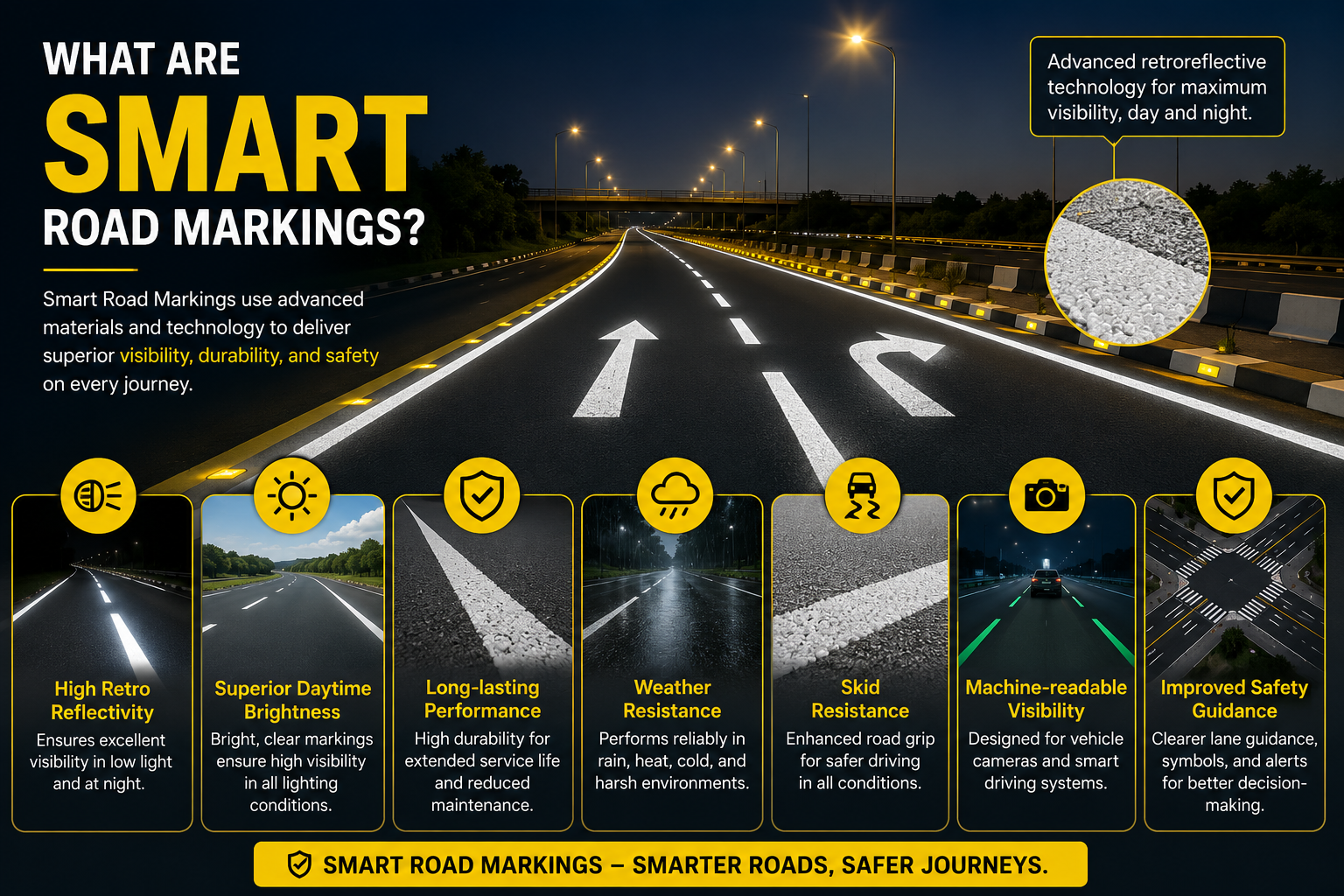
These features allow road markings to actively contribute to safer and more efficient transportation systems.
The Importance of Visibility and Traffic Control
Road markings provide continuous visual guidance that helps road users make safe decisions. Clear lane lines, directional arrows, pedestrian crossings, stop lines, and edge markings reduce confusion and improve traffic discipline.
In high-density urban environments, well-maintained markings play a crucial role in minimizing traffic conflicts and improving roadway efficiency.
How Smart Road Markings help
Connected transportation systems rely on accurate lane recognition and road guidance. Advanced Road Marking Paint for Smart Cities helps ensure that vehicles, sensors, and intelligent traffic management systems can accurately interpret road conditions and traffic patterns.
As transportation networks become increasingly automated, the quality of road markings will become even more important.
Challenges on Modern Urban Transportation Networks
Despite significant technological advancements, many cities continue to struggle with transportation-related challenges.
1. Poor Traffic Visibility
One of the most common causes of roadway confusion is inadequate visibility. Faded markings become difficult to identify during nighttime driving, rain, fog, and other adverse conditions. Poor visibility can result in:
- Lane departure incidents
- Missed turns
- Driver confusion
- Increased accident risks
2. Rising Road Accidents
Road safety remains a major global concern. According to the World Health Organization (WHO), road traffic crashes claim approximately 1.19 million lives every year worldwide.
Many accidents occur due to poor visibility, inadequate guidance, and unclear road layouts. High-performance road markings help address these challenges by providing consistent visual communication.
3. Traffic Congestion
Urban congestion often results from poorly organized traffic flow. Missing or worn-out lane markings contribute to erratic driving behavior, bottlenecks, and inefficient road utilization.
4. The Need for Smart Infrastructure
As cities become larger and more complex, traditional road maintenance approaches are no longer sufficient. Smarter infrastructure solutions, such as advanced pavement marking systems are becoming essential for supporting future mobility requirements.
Why Is Thermoplastic Road Marking Paint Used in Smart Cities?
Among the various pavement marking materials available today, thermoplastic road marking paint has emerged as one of the most effective solutions for smart city infrastructure projects. Its combination of durability, visibility, and cost-effectiveness makes it ideal for modern transportation networks.
i) Retro Reflectivity for Day and Night Visibility
Retro reflectivity is one of the most important performance characteristics of road markings. It refers to a marking’s ability to reflect vehicle headlights back toward drivers.
High-quality thermoplastic markings embedded with reflective glass beads provide excellent visibility during:
- Nighttime driving
- Rainy weather
- Foggy conditions
- Low-light environments
This is where reflective road paint plays a vital role in improving road safety and driver confidence.
ii) Durability Under Heavier Conditions
Urban roads experience constant wear from:
- Heavy vehicle movement
- Extreme temperatures
- Rainfall
- UV exposure
- Surface abrasion
Thermoplastic road markings offer exceptional resistance to these conditions, helping maintain visibility and performance over extended periods.
iii) Reduced Road Closure Time
Unlike conventional paint systems, thermoplastic markings cure quickly after application. This allows contractors to complete projects faster while minimizing disruptions to traffic flow.
iv) Supporting Lane Discipline
Clear lane markings improve driver behavior by encouraging lane discipline and reducing sudden movements. This contributes to smoother traffic flow and better road utilization.
The growing adoption of Road Marking Paint for Smart Cities reflects the increasing recognition of its role in supporting efficient urban mobility.
The Role of Smart Road Markings in Traffic Safety Solutions
Road markings are among the most cost-effective traffic safety solutions available to transportation authorities.
i) Improving Driver Awareness
Clearly visible markings help drivers understand roadway geometry, lane configurations, and traffic priorities. This reduces uncertainty and enhances decision-making.
ii) Pedestrian and Cyclist Safety
Pedestrian crossings, bicycle lanes, school zones, and safety markings create safer environments for vulnerable road users. As cities encourage sustainable mobility, these markings become increasingly important.
iii) Supporting Emergency Response
Dedicated bus lanes, emergency vehicle routes, and transit corridors rely on highly visible markings to ensure operational efficiency and public safety.
iv) Reducing Accident Risks
Road markings function as a universal language understood by all road users. Consistent visual guidance helps reduce confusion and lowers the likelihood of accidents.
Emerging Technologies Shaping the Future of Smart Road Markings
The next generation of road marking technologies is designed to support intelligent transportation ecosystems.
i) Reflective Road Paint and Glass Bead Technology
Modern glass bead technology significantly enhances retro reflectivity, allowing markings to remain visible even under challenging environmental conditions. These systems improve driver reaction times and contribute to safer road environments.
ii) Profile Markings and Audible Safety Features
Profile markings provide tactile and audible feedback when vehicles cross lane boundaries. These markings help prevent unintended lane departures and improve driver alertness.
iii) Road Markings for ADAS
Advanced Driver Assistance Systems (ADAS) and autonomous vehicles depend heavily on road markings for navigation.
Lane-keeping systems, adaptive cruise control, and automated driving technologies require highly visible and well-maintained markings to function effectively.
iv) Integration with Connected Transportation Infrastructure
Future smart roads may integrate road markings with:
- Vehicle-to-Infrastructure (V2I) communication
- Smart traffic signals
- Roadside sensors
- Real-time traffic management systems
This integration will further improve traffic efficiency and safety.
Standards and Specifications for Smart City Road Markings
To ensure reliability and performance, road marking systems must comply with established industry standards.
i) Understanding Retro reflectivity Requirements
Retro reflectivity measurements help transportation authorities evaluate visibility performance under nighttime driving conditions. Higher retro reflectivity levels generally result in improved safety outcomes.
ii) BS EN 1871 Standards for Thermoplastic Road Markings
BS EN 1871 establishes performance requirements for road marking materials, including:
- Visibility
- Durability
- Color retention
- Skid resistance
iii) AASHTO M249 Performance Specifications
AASHTO M249 is widely recognized for defining quality requirements for thermoplastic pavement marking materials used in transportation projects.
iv) MoRTH and IRC Guidelines for Indian Road Infrastructure
In India, road marking systems are governed by guidelines established by the Ministry of Road Transport and Highways (MoRTH) and the Indian Roads Congress (IRC), ensuring consistent quality and safety across infrastructure projects.
Why Choose Prime Roads for Smart City Projects
As a leading road marking paint manufacturer and road marking paint supplier, Prime Roads provides high-performance thermoplastic road marking solutions developed to meet the evolving needs of modern transportation infrastructure.
With a strong focus on quality, innovation, and durability, the company offers products suitable for highways, urban roads, airports, industrial zones, and smart city projects. Our thermoplastic road marking solutions are designed to deliver:
- High retroreflectivity for enhanced day and night visibility
- Excellent resistance to traffic wear and environmental conditions
- Superior skid resistance for improved road safety
- Long-lasting performance with reduced maintenance requirements
- Quick application and fast drying characteristics
- Compliance with recognized national and international standards
By combining advanced manufacturing capabilities with industry expertise, Prime Roads supports government agencies, contractors, consultants, and urban development planners in implementing reliable pavement marking systems that contribute to safer, more efficient, and future-ready transportation networks.
Key Factors for Effective Road Markings
Choosing the right road marking paint is critical for ensuring safety, durability, and smart mobility performance. Here are the primary factors:
- High retroreflectivity for superior day and night visibility,
- Long-term durability under heavy traffic and harsh weather conditions,
- Compliance with standards such as BS EN 1871, AASHTO M249, and MoRTH guidelines,
- Compatibility with ADAS and autonomous vehicle systems.
Additionally, fast-drying properties, skid resistance, and low maintenance requirements help support efficient traffic management and sustainable smart city infrastructure.
End Words
The future of intelligent transportation depends on infrastructure that can safely support increasing traffic volumes, connected technologies, and evolving mobility requirements. Road Marking Paint for Smart Cities serves as a critical foundation for achieving these goals by improving visibility, enhancing traffic management, supporting intelligent transportation systems, and reducing accident risks.
Achieve superior road marking performance with Prime Roads, Contact us Now!


